
You can now watch the webinar online here!
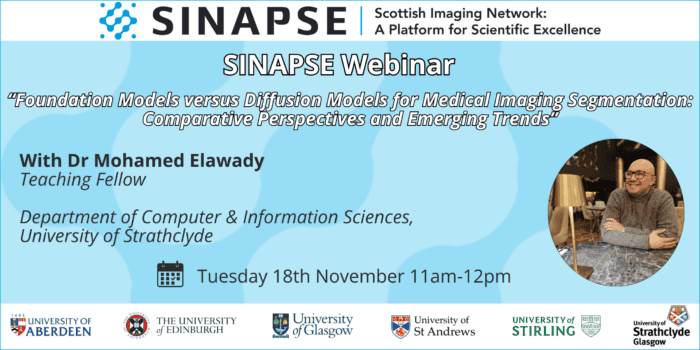
We are delighted to be joined by Dr Mohamed Elawady for this SINAPSE webinar.
Title: Foundation Models versus Diffusion Models for Medical Imaging Segmentation: Comparative Perspectives and Emerging Trends
Abstract: Medical image segmentation has advanced significantly through two prominent AI paradigms: foundation models and diffusion models. Foundation models, such as MedSAM, MedSAM2, are large-scale pretrained architectures designed to generalize across diverse imaging modalities and tasks, enabling prompt-based and zero-shot segmentation with high scalability and adaptability. In contrast, diffusion models produce segmentation masks via iterative denoising, offering improved boundary accuracy and uncertainty estimation; examples include MedSegDiff. While foundation models prioritize broad generalizability and efficiency, diffusion models focus on fine-grained precision and structural awareness, with ongoing research exploring hybrid approaches (i.e. SAM-DiffSR) that combine the strengths of both.
Bio: Dr. Mohamed Elawady is a Teaching Fellow in the Department of Computer & Information Sciences at the University of Strathclyde, specializing in computer vision and deep learning. His research tackles critical challenges in healthcare, sustainability, urban management, occupational safety, digital media integrity, and the creative industries. He has co-led projects on reducing food waste in medical facilities, detecting workplace hazards, and analysing smart city infrastructure, working closely with academic and industry partners across Europe. His medical imaging research focuses on early cancer detection using ultrasound, while his recent work explores trusted media distribution and computational art analysis. Dr. Elawady holds a PhD in Computer Vision from the University of Lyon and an Erasmus Mundus European MSc in Computer Vision and Robotics. He has published in leading venues in computer vision such as ICCV, VCIP and CAIP. He has mentored over 50 undergraduate and postgraduate dissertations and supervises several international PhD candidates. In addition, he serves as a reviewer for top journals and has delivered invited talks at major institutions.